Look Out For Solar Eclipse On Monday, April 8

Image: NASA
Depending on the weather, the total solar eclipse can be seen here in Mercer County starting at 1:50 p.m. and reach its greatest extent—96.5 percent coverage of the sun—at 3:07 p.m., according to NASA. It is the last solar eclipse that will be viewable from the continental United States until 2044.
Robert Moore
Herald Staff
[email protected]
Mercer County is not in the path for the totality of the solar eclipse on the afternoon of Monday, April 8, but we should still get a spectacular show, with the area predicted to see 96.5 percent of the eclipse, according to the National Aeronautics and Space Administration’s website.
Experts are warning the public not to look directly at the sun, even during the eclipse. The Mercer County Public Library is offering free eclipse glasses to the public. The limit is four per family.
According to NASA, the eclipse will begin in Mercer County at 1:50 p.m., reach its maximum at 3:07 p.m. and end at 4:23 p.m. The last solar eclipse to be viewable in Mercer County happened in 2017, which was called the Great American Solar Eclipse because it was the first time in American history that a total solar eclipse was visible only in the United States.
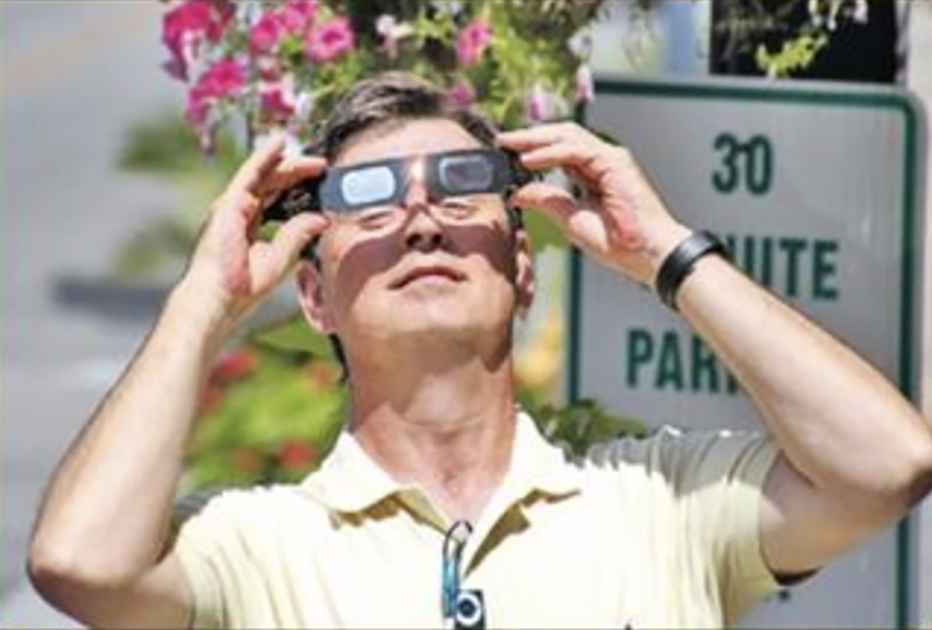
The Harrodsburg Herald/Robert Moore
Jerry Sampson stepped out of his antique shop to view the Great American Solar Eclipse in 2017.
Of course, what you can see of the eclipse depends on the weather. Forecasts for Mercer County were calling for cloudy weather at press time. The National Centers for Environmental Information created an interactive map that provides stargazers with information for various localities, including the viewability of the eclipse. While the map did not contain information about Harrodsburg at press time, it did include information for Lexington Bluegrass Airport, which is roughly half an hour away. The map predicted viewability at the airport would be 62.3 percent.
According to NASA, a total solar eclipse happens when the moon passes between the sun and the earth, completely blocking the face of the sun. People located in the center of the moon’s shadow will experience a total eclipse. The sky will darken, as if it were dawn or dusk. Weather permitting, people in the path of a total solar eclipse can see the sun’s corona, the outer atmosphere, which is usually obscured by the bright face of the sun. A total solar eclipse is the only type of solar eclipse where viewers can momentarily remove their eclipse glasses—which are not the same as regular sunglasses—for the brief period of time when the Moon is completely blocking the Sun.
In addition to the United States, the 2024 total solar eclipse will pass over Mexico and Canada. The totality—the narrow area where viewers can see 100 percent of the eclipse—will impact eight Kentucky counties and clip portions of four others, entering the Commonwealth around 3 p.m. Eastern time in parts of Fulton and Hickman counties before crossing Ballard, McCracken, Livingston, Crittenden, Union and Henderson counties along the Ohio River. The totality will also pass over small portions of Carlisle, Graves, Webster and Daviess counties.
According to NASA, there can be as many as three solar eclipses of all kinds—including annular and partial eclipses—each year, and about two total solar eclipses every three years. While solar eclipses are fairly common, they’re not viewable everywhere. The next total solar eclipse to be viewable in Kentucky and other parts of North America won’t happen until Aug. 22, 2044.
The total solar eclipse on April 8 will sweep across 13 states, including Kentucky, and the Commonwealth is expecting at least 150,000 visitors next week, with more than 1 million travelers predicted to drive through Kentucky to nearby viewing spots along the main path.
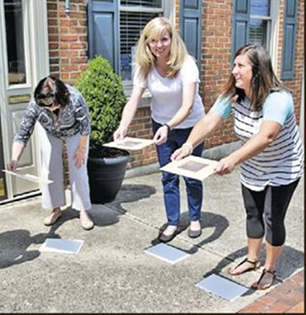
Debbie Humber, Mary Caines and Nina Robinson of Whitenack and Souder Insurance watched the 2017 eclipse with pinhole projectors. (File image).
Eye Safety During a Total Solar Eclipse
Except during the brief total phase of the eclipse, when the moon completely blocks the sun’s face, it is not safe to look directly at the sun without eye protection, according to NASA. Viewing any part of the sun through a camera lens, binoculars, or telescope without a special-purpose solar filter will instantly cause severe eye injury.
When watching the partial phases of the solar eclipse, you must look through safe solar viewing glasses—eclipse glasses—or a safe handheld solar viewer at all times. Eclipse glasses are not regular sunglasses. Sunglasses, no matter how dark, are not safe for viewing the sun. Safe solar viewers are thousands of times darker and ought to comply with international standards. NASA does not approve any particular brand of solar viewers.
- Always inspect eclipse glasses or handheld viewers—especially eclipse viewers that might be left over from the 2017 eclipse—before use. If torn, scratched, or otherwise damaged, discard the device. Always supervise children using solar viewers.
- Do not look at the sun through a camera lens, telescope, binoculars, or any other optical device while wearing eclipse glasses or using a handheld solar viewer. According to NASA, the concentrated solar rays will burn through the filter and cause serious eye injuries.
- If you don’t have eclipse glasses or a handheld solar viewer, you can use an indirect viewing method, such as a pinhole projector, which has a small opening—for example, a hole punched in an index card—and projects an image of the sun onto a nearby surface. With the sun at your back, you can then safely view the projected image. Do not look at the sun through the pinhole.
Here are some tips for viewing the eclipse safely, courtesy of NASA.
• View the sun through eclipse glasses or a handheld solar viewer during the partial eclipse phases before and after totality.
• You can view the eclipse directly without proper eye protection only when the moon completely obscures the sun’s bright face, during the brief and spectacular period known as totality. According to NASA, you’ll know it’s safe when you can no longer see any part of the sun through eclipse glasses or a solar viewer.
• As soon as you see even a little bit of the sun reappear after totality, immediately put your eclipse glasses back on or use a handheld solar viewer to look at the sun.
• Don’t forget your skin. Even during a partial or annular eclipse, or during the partial phases of a total eclipse, the sun will be very bright. If you are watching an entire eclipse, you may be in direct sunlight for hours. Remember to wear sunscreen, a hat, and protective clothing to prevent skin damage.
For more information about the eclipse, visit nasa.gov or GreatAmericanEclipse.com.
The Mercer County Public Library (109 West Lexington Street) is offering free eclipse glasses. Limit is four per family. For more information, call 859-734-3680 or visit online at mcplib.info.